Background

Tuesday, July 5, 2016

Breaking the Silence: Why ALL Educators Need to be Advocates


An advocate? Who? Me? I’m not THAT person. I’m not an eloquent public speaker. I’m uncomfortable sharing my thoughts and opinions with others I don’t know. The fear of saying something “wrong” keeps me quiet. The last thing in the world that I’d want to do is be in the media spotlight. I’m not an administrator. I’m not really involved in politics. I’m a classroom teacher. I’m not sure that I have anything valuable to share. And besides, who’d listen to me?
That was me and let’s be honest; it still is me in a few respects. This journey that I’m on is taking me way out of my comfort zone! It’s scary! I feel vulnerable. Why am I blogging and speaking out about the importance of being an advocate? Even more importantly, for the many educators who are like me, why you should break your silence too.

An advocate- a champion, supporter, backer, proponent, spokesperson, a person who publicly recommends or supports a particular cause or policy

I believe that there is not one great educator who isn’t ALREADY an advocate. There is not one great teacher who isn’t ALREADY a leader of their classroom.

Dozens of times over my career I’ve shared my opinion about providing more resources and opportunities for my students. Multiple times I’ve shared ideas about how to make our schools better for our students, families, and teachers. The difference now is that I’m sharing my thoughts with others than just my closest colleagues. Why now? Recent personal experiences have opened my eyes, and I've seen the overwhelming need for those willing and able to speak up for those who are not in a position to advocate for themselves. The truth is, I’ve always been an advocate for my students. I've always been an advocate for teachers. I’ve just never given myself enough credit.

Educators, by their very nature, want what’s best for kids. We enter the teaching profession for many reasons, but a common one is to make a difference in the lives of our students, to have an impact on their future, and to make the world a better place.

What I’ve come to realize lately is that being an advocate is telling a story. It’s the story of someone whose voice remains unheard by the masses, a story of someone less powerful, and a story of someone in need. Every educator can share a story. So every educator can be an advocate for kids! Being an advocate means that you share your story with a larger audience and with those who make decisions like our legislators. That’s where it takes a little courage.
We’re not blind to how policies, laws, and even deep-rooted traditions negatively affect students in our classrooms. Can we hide in the background forever and depend on only a few to lead the way towards change? If we say nothing, do nothing to improve education, are we equally guilty as those who are making the changes that we feel are hurting kids? Teachers? Schools? How long can we tolerate the injustices we see? Isn’t it our moral imperative to ensure that ALL kids are learning at high levels in a supportive environment?

How Can We Become Better Advocates/Story Tellers?

Listen and Understand A Person’s Perspective: The last three weeks of my personal life completely turned upside-down. My elderly mother spent nearly three weeks in ICU and a rehab center. How quickly life can change! What slapped me in the face, with so many decisions about her care, was the importance of listening and understanding her perspective. Experts, laws, procedures, documents, and medical jargon swirled around my head, with seemingly little concern for taking the time to listen to the wishes of my mom, the patient. The similarities to education were eye-opening and caused me to reflect upon my teacher behavior and language. I asked myself some questions. How can I provide more opportunities for my students/parents to express their feelings, challenges, and needs honestly? How sincere are my efforts to make sure that there is two-way communication? What have I done to ensure understanding?

Show Empathy: You’ve heard the advice to “walk a mile in someone else’s shoes” and not to make assumptions or judgments. Immersing yourself in the situation of someone else provides insights into the problems that they face. What issues do you see kids facing that gets you “fired up”? Speak from a place of passion! Your connection to an issue, person, or cause facilitates your ability to be a better advocate.

Stand Up for Rights/Concerns and Ask Questions: Some of the most vulnerable to the laws and policies that hurt rather than help are those with little to no voice. As educators, we can stand up for what we know is right, empower those without a voice and bring awareness to changes that need to happen. Understanding laws and policies is a definite plus, but you don’t need to be a scholar. Be informed. Make sure that decisions are in the best interest of those for whom you advocate. Ask questions! It’s a non-threatening way to find out information.

Teach Students How to Advocate For Themselves: Technology provides multiple ways for students to record and share their thoughts, feelings, ideas, and experiences. As educators, we should be empowering our students by encouraging them to share their voice with a global audience. To not give students a choice in how they access information and express their learning in the 21st century is malpractice in my opinion. Students cannot only learn to advocate for themselves, but they can also learn to advocate for others.

A story- it starts with the main character who faces a problem. Is there a single educator who cannot share a story of a struggling student? What would help them overcome their struggles? And are we as teachers and leaders advocating for ourselves? Or are we just accepting what’s given to us even though our hands are tied, and we’re often unable to do what we know is best for kids? Share your story publicly via a blog or other means and advocate for those changes we need. Be a leader. Know your impact. Collectively our voice will be heard. It’s time for educators to break their silence.

Friday, June 24, 2016

10 Surefire Ways To Keep Your Cup of Mojo Full This Summer

Mojo is the moment when we do something that's purposeful, powerful, and positive and the rest of the world recognizes it.
-Marshall Goldsmith

Summertime is the perfect time to fill your cup of mojo! Here are TEN surefire ways from the Compelled Tribe to keep or get back your mojo this summer.

Exercise - @Jennifer_Hogan
I find that when I get to exercise, it keeps me motivated, energized, and confident. Exercise is a time when I can disconnect from the world and just be “inside my head.” It allows time for ideas to percolate without interruption... time that I value and appreciate. It also provides the whitespace I need as an introvert. For me, it encourages creativity and problem-solving while the endorphins are being released! Done consistently, it’s a true mojo-maker!

Connecting - @jon_wennstrom
For me, I draw energy from being around positive people. Connecting with educators during summer learning sessions, sharing and learning from others on Twitter about books we’ve read, and of course blogging and reading blogs. I’m definitely an extrovert and being around other educators helps inspire me and always leads to new ideas to implement and helps me keep my mojo! 

Theater - @sandeeteach
I love Broadway musicals, plays, and other theatrical productions. It’s a way for me to escape and immerse myself in a story. One of my favorite theaters spoofs popular shows. For example, this year two of the shows will be “Indiana Bones Raiders of the Wal-Mart” and “Captain American Fork The Worst Avenger”. (American Fork is the city where I grew up.) The actors and actresses are masters of improvisation which makes for a night of laughter. Another favorite theater performs in the round which is always a delightful experience. There are beautiful theaters in downtown Salt Lake City for Broadway musicals and outdoor shows in many local communities. For a few hours, I can lose myself in another world. But upon further reflection, I always relate the experience to teaching because that’s just what teachers do. We get ideas that benefit our students from everywhere. 

Find a good read, or two - @Vroom6
There are lots of ways to find joy and rejuvenate during the summer months. And, I am all about work hard, play hard. With that, one of the greatest joys I get from the summer months, and a way in which I keep my mojo running full steam ahead, is by catching up on some of that much needed reading that took a back seat during the school year. Often times the days we are in session with students and teachers are filled with more scripted reading and writing. So for me, it is the summer months that I get to find that much anticipated new release on best practices in our field. Whether striving to become a better leader, or a better learner, it is the books that I carry with me to the beach, the pool or the park that I enjoy the most.

Dream big together - @allysonapsey
When my mojo needs a pick me up, I dream about what could be for our students, but I don’t do it alone. Just like everyone else, I find myself focusing on the trees rather than the forest from time to time. When monotony sets in, I push back by collaborating with the amazing teachers I work with. I am astounded after each conversation--we feed off each other, we divide and conquer, and we multiply our creativity for the sake of our students. Through these type of conversations this year, we came up with an amazing service learning project, we started plans for a Makerspace, we piloted new 
reading initiatives, we shared professional reading that has inspired us and so much more. While we are dreaming big together, we are building stronger relationships, laughing, and challenging each other. 

Pause and Reflect - @KarenWoodEDU
When my mojo needs some rejuvenation, (and it sometimes does), I first take a few minutes to reflect.  I find that sometimes my initial desire to “rejuvenate my mojo” may have my efforts focussed in the wrong areas or in areas which may not be productive for educators or students in the long run.  Reflection leads to focus and clarity.  From clarity goals can be set and then the fun begins!  Once my goals are established I jump in full force and do so with collaborative efforts.  It is very important that the shared vision of success is truly understood by all.  The last strategy I feel is essential for rejuvenating mojos is time to step away from work.  I admittedly do not do this well, however I find when I can clear my head (by going to the beach, going for a walk, kayaking, swimming, or practicing yoga/meditation, etc.) I return refreshed, focussed, and ready to ramp up my mojo and the mojos of others around me. 

Get into some music! - @PrincipalStager
I was a music major in college and a music educator prior to becoming a principal. Whenever I need to get my mojo back or need to decompress, I find a piano and PLAY. I play in a group at my church so I have the opportunity to play rather often. I understand not everyone has the ability to sit down and play a musical instrument, but when I don’t have a piano to play, I drive in my car or just put my headphones in and JAM! There is nothing like a great playlist of uplifting and energetic music to get your energy back and your cup overflowing! This is my sure-fire way to get back on track.

Make a “bucket list” - @jodiepierpoint
I decided to make a “bucket list” of things I wanted to accomplish within a year, but I’m finding summer is a perfect time to accomplish them.  Things such as volunteering and baking cookies for friends have been real pick me ups! Training for a quarter marathon has led into a half, simply because I’m out with great friends chatting while I’m doing it.  I check my list all the time, call a friend, and pick an activity to do - it’s a great way to rejuvenate not only myself, but others too!

“What if People” & Quiet Time - @Debralcamp
I do my best thinking when I am with people that like to say “what if”.  There is something about the words “what if” that allows walls to come down.  When discussions are lead with the words “what if” it takes away the threat of there being wrong answers and allows for brainstorming to happen in a way that doesn’t in a lot of conversations.  I find it very motivating to be pushed and pulled by other people’s thoughts and ideas.  Positive energy comes when people work together and create as a group. There is a collective product that is created as well. I find on the flip side that quiet time and reflection after being with “what if people” takes me to a space in my head where more ideas can be generated.  Revisiting and reflecting again with the same group consistently allows for new ideas to develop and to be tried. (They don’t always work but the process sure is fun and motivating.)

Balance - @Abond013
Often times when I am feeling overwhelmed, I find that I need to prioritize. It is important for educators in any role to find time to take care of themselves. We need to give students our best and that is challenging when we are running on empty. Besides exercising, traveling, and spending time with family or friends, I find that fueling my passion keeps me going. For example, if you are passionate about literacy, continue to take interest and learn more. Surround yourself with people who share your passion.


Tuesday, June 21, 2016

Five Hours of Instruction


Occupational Therapist: Draw the face of a clock and the time, ten minutes to twelve.

My mom drew a circle and the top of a stopwatch.

Therapist: Can you draw the face of a clock? Start with writing the numbers.

Grimacing, my mom took a deep breath and attempted to write some numbers. Some were correct; some numbers weren't. She knew some numbers were out of sequence but struggled to identify which ones needed to be rewritten.

The therapist patiently gave her feedback and watched my mom as she corrected her mistakes. Each time that she corrected her mistakes, she came closer to being able to complete the task. She was not successful the first day or the second. But by the third day, she could confidently draw a clock face representing any time. A simple task was a huge triumph!

Recently, my mom was in ICU for over a week. The combination of Afib, a UTI, and her age reeked havoc on her mind and body. She is now recovering in a rehab center and hopefully will be released soon. The whole ordeal left me with many hours to reflect. Because I'm a teacher, everything that happened/is happening seems to be related to education. Learning is a process, messy, and takes time.

Next year, I will be required to give five more benchmark tests. That's five more hours of lost instructional time. My students are already subjected to over 16+ hours of benchmark/state testing. Although I'm not opposed to some testing and understand the purpose, I fail to understand the need for more benchmarks. So, I'm asking myself,

"What could I do with five hours of instruction?"

I'd have more conversations. Relationships with students are built through multiple mini conversations. It's important for me to know their interests, challenges, hopes, and aspirations. I cannot be an effective teacher without a trusting relationship. Students need to feel valued and know that I care. I need to know when and how to push and when to pull back. I need to know them inside, outside, forwards, backward, and inside-out. That takes many conversations and more time.

Classroom discussions are also important. It's during these times when we learn about each other, respectfully listen to various points of view, gain an understanding of personal experiences, and demonstrate empathy. Conversations lead us to ask better questions, research, problem-solve, and think critically about what we read. Whether in small groups or as a whole class, when we have conversations, we are learning, and it's visible.

I'd have more conversations and conferences with individual students about their goals and progress. Specific feedback, while kids are learning, is much more effective than an arbitrary grade on paper after a three-week unit. Similar to the therapist working with my mom, learning is a process, and specific, timely, positive feedback is what helps a learner reach mastery.

I'd give time for kids to be creative. Rigid schedules, bells, initiatives, and the pressure to produce high scoring test-takers have squelched creative expression. The suggested schedule from my district allows 1 1/2 hours (combined total time) each day for science, social studies, art, music, dance, drama, and physical education. It's the most unrealistic and absurd part of the schedule. I'm not an art teacher, but I don't consider art as an "everybody color, cut, and glue this down" in 30 minutes once a week as art instruction. I'm afraid that many teachers, crammed for time, leave no time for kids to express their thinking through the Arts. Kids need time to create, wonder, explore, make, and innovate. They need time to use high tech, low tech, and no tech to design, problem-solve, make mistakes, and learn from those mistakes. Kids creatively thinking are highly engaged in learning, in the zone, and empowered with making their own choices.

With another hour of instruction, I'd encourage my kids to discover and follow their passions. For the last couple of years, one of the most rewarding activities that I've done is to give my kids time to work on a Genius Hour/Passion Project. Nothing can replace the enthusiasm of kids teaching others about a topic that is part of their soul. Nothing even compares to the learning that happens during an Edcamp. The more I move to a student-centered classroom, the more visible learning I see and experience. I'm learning alongside my students.

My list for what I could do with five more hours of instruction keeps growing. I could include simulations, PBL, science labs, play, and more time for reading a good book. I'm trying to create a classroom atmosphere of trust, where we make and learn from mistakes, where kids develop a growth mindset and a real love for learning.

Technology facilitates my ability as the teacher to use formative assessments multiple times throughout the day. I see real-time data and give feedback to my students during the process of learning. I can see, while teaching a lesson, who is understanding, and who needs a little more support. I know when learning is occurring and when it's not. So I fail to understand, why I need to use five hours of instruction to administer a paper test with multiple choice questions. Why are we being required to give tests that give us the information we already know? The data will not help my team (PLC) or me guide instruction.

Help me to understand the WHY.

Is our district mandating so much benchmark testing out of fear that our students won't score high enough on the SAGE tests? Are teachers not trusted to make professional decisions about their students? If benchmark testing is not a "gotcha", why is it not an optional tool? What is the goal? Are we becoming more obsessed with the end product rather than learning as a journey? Are we building a testing culture or a culture of learning?

I suggest that instead of looking at more statistics- to come into my classroom five times throughout the year for an hour.


My students are remarkable innovators of change. 
We simply don't have time to waste! We're busy changing the world!

 
Is there a need for more data?

Saturday, June 11, 2016

Zombie Science- Surviving the Last Day of School!


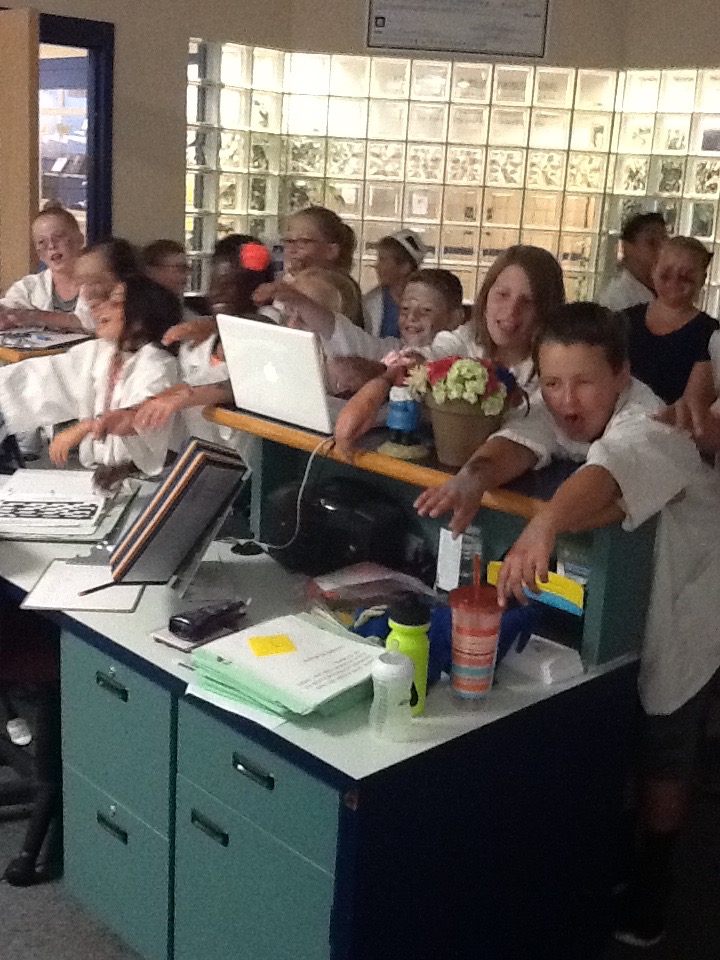
Kids were lined up ready to come in the room. I cracked open the classroom door and pressed the button on the fog machine. Someone screamed! (Sometimes being in a portable is really an advantage.) The room was dark and only lit by black lights. I also had a camouflage curtain at the door so the kids couldn't see into our room. A few more spurts of fog set the mood...and heightened their curiosity. And then....I came out on our little balcony! Kids tentatively came into our classroom. Hee Hee Hee I didn't have the whole room decorated, but I did have a table of potions, jars of eyeballs, brains, and rats at the entrance. Spooky music was playing in the background. Kids were deliciously surprised and happy that they had come to school on the last day.

The first activity was to experiment and create the perfect recipe for fake blood. Each team had a tray of science equipment and a variety of supplies. (ketchup, cocoa powder, shampoo, Karo syrup, food coloring, chocolate syrup, and cornstarch) After making some blood, we went and haunted the office, the lunch ladies, the media center and a few other classes who were also ending the year.

Other activities during the day included making different kinds of slime and ice cream. We washed up before lunch and afterward had our class drawings and other celebrations. Since we only had a 1/2 day, we didn't have time to do everything. (I had purposefully over planned.)

It was a fun last day of school!

That's the highlight reel! "Great Teacher Ends the School Year with a Bang Instead of a Fizzle!"

************************************
Truth- I was exhausted! The last week of school is packed with activities and the responsibility of completing report cards and paperwork. I was functioning on basically no sleep. I ALMOST opted for the easier route of showing a movie like many others. But as I hurried out of the door, I paused to check the Voxes from my tribe. I played two, and it was enough. There was no way that I could live with myself or face my PLN by opting for easy. I never have. I couldn't do it now. Inspired to keep going, I took a deep breath and told myself just to push through the day and make it a memorable experience for my kiddos. I'm glad that I did!

Not everything went perfectly! In fact, I only had about 7 minutes to get dressed! I basically just slapped make-up on and ratted my hair a bit. I wanted to do more...just didn't have time. I leaned on my teaching experience to get me through the day. I didn't have time to do all that I wanted to do for the kids. I didn't get all of the thank-you notes written. (I'm still working on those and will have to mail them.) I should have planned better earlier. But, I didn't. Considering everything, I'm just happy that I survived the last day of school!

Saturday, June 4, 2016

Hats That Empower


I've always been inspired by Angela Maiers @angelamaiers and the #YOUMATTER movement that she started. Thursday, I tried to watch the #leadupteach Blab featuring Angela as a guest. For some reason, I had plenty of tech issues. But that didn't stop me from hearing about and seeing the T-shirts that kids wore as part of an activity she did with them to share their genius. Of course, I couldn't afford purchasing T-shirts for the kids, but I did have a collection of white hats. I found them several years ago in a thrift store (brand new) for $2.00 ea. I bought them because I always grab items that I can use for drama. They were just items in my storage and because I'm trying to downsize, I thought they'd be perfect for the kids to use instead of T-shirts. (I really don't know where I'll be in my career in a couple of years. Using the hats this year made sense.)

I've had kids sign T-shirts and even hats before for an end of year activity. But, I haven't used that activity with a focus on sharing each others' genius. Just the little shift of focus made a HUGE difference! Kids loved them!

Today was especially sweet because it was our last day together as a whole class. About 5 of my boys are leaving for a scout camp. (That's the negative of being on year-round.) We celebrated by signing hats, eating pizza that the kids had earned from ThinkThroughMath and ice cream after lunch. Most of our day, we worked on our book. Yes, we're still working on it! That's another blog post.


One of my boys touched my heart. I was sitting on the couch, surrounded by kids signing hats, listening to the "kid talk", when I overheard him say, "This hat is so cool! These hats will make us feel strong when we wear them. I'm going to wear it every time someone makes fun of me for dancing." You see, he's a great dancer but has been told that "Boys don't dance." He's also really great at gymnastics and break dancing is his specialty. He loves it! It's his passion! His peers wrote all over his hat about how he'd be a star some day and to follow his passion for dancing and gymnastics. They recognize the genius in him!

I hope he wears his hat! I hope it empowers him to dream big and follow his passion! He inspired me today.

Monday, May 30, 2016

Beyond the Basics- What My Students Learned This Year

Inspired by Kara Welty's @kara_welty blogpost I asked my students to write the top 10 things that they learned in 5th grade. Here is a compiled list of some of their responses. (I did not include specifics about a content area or more personal responses.) My heart did a little happy flip when I read their answers. We learned so much more together than the required curriculum standards.


  1. Just try!
  2. It’s good to make mistakes.
  3. Never leave someone out. You accomplish more as a team.
  4. Set goals to help you improve.
  5. Read! Read! Read!
  6. Be yourself!
  7. I learned to work as a team and to build each other up.
  8. I learned to learn from my mistakes.
  9. I learned to be more responsible.
  10. I learned to ask questions.
  11. I learned that leaders listen and don’t just think about what they want to say.
  12. I learned how to become a better person.
  13. I learned how it’s important to laugh.
  14. I have learned that school is FUN!
  15. To keep our classroom clean
  16. Coding is AMAZING!
  17. How to not be that shy
  18. To reach out for help
  19. To take brainbreaks
  20. I learned that it’s cool to have couches and comfortable places to work.
  21. I learned to push myself. I pushed myself in reading and became a better reader.
  22. I learned to try my best.
  23. I learned that some questions have many answers.
  24. How to be polite
  25. To never give up
  26. I learned to follow my passions!
  27. The history of America and why we should be grateful to live in this country
  28. To have an awesome time
  29. To have fun as you learn
  30. To have high goals
  31. Have a positive attitude
  32. A mistake just means you’re learning
  33. Treat others how you want to be treated
  34. I learned how to love math.
  35. I can change the world!
  36. I learned a lot of math that I actually understand for the first time in my life.
  37. I learned a lot about writing and how important it is for a leader to know.
  38. To connect with people around the world and learn from them
  39. First, I learned how to speak in front of people. I’m not as nervous as I used to be.
  40. I learned that even if you know a lot about a certain subject that you can still learn more.
  41. We learned a lot of science but we had fun at the same time
  42. I learned a LOT of technology!
  43. I learned to think and show evidence
  44. To have plan B, C, D, etc.
  45. I learned to not worry if I’m not really good at something YET.


Sunday, May 29, 2016

I Failed

End of level testing is finished, and I have the data. But, I don't need the official test scores to tell me that I failed to reach one of my students. The worst part is that I must confess that I know that I didn't do everything in my power to help this student. I know I could have done more. I needed to be a little more patient. I know that I needed to scaffold and differentiate his learning more. He needed more one on one time with me. All the excuses in the world for why I didn't do more seem so shallow now.

Five more days to make a difference. I've been enthusiastically doing a countdown of sorts to keep going strong- to keep the kids learning. The reality is that the year is going to end, and I will not have made a difference for this child. I failed.

Logically I know that I can't reach every child, but I want to. I always believe that I can be the one to make a difference. I can't help but think of the impact of my failure. This student still can't read proficiently. He still is struggling with math. Many of his skills are at a 2nd-grade level. Will I be a cause for him not graduating? Getting a good job? Having a successful life? It makes me cringe.

There were times this year when I wanted to give up on him. He was not an easy student to have in class. There was even once where I caught myself being more than frustrated and almost angry that his scores brought down my class average. That's what the testing pressure does. It made me forget (even momentarily) that I teach kids, not test takers.

I didn't have to, but I apologized to his parents for not being able to do more. Looking in their eyes was hard. They are at their wits end and feel helpless about how to help their son. We tried so many strategies to help him improve this year with minimal effect. I let the parents down. I let my student down.

I feel awful.

The only thing that I can think of is to make a stronger commitment to try harder next year. I can also hope that this student's teacher for next year will be the one that can make a difference. My student did experience growth this year but not enough to get him on grade level. But, I hope he learned he is not a failure. I hope he gained some confidence in himself. I hope he learned the power of YET. I hope he continues to have big dreams and follows his passion.

I hope.